Photographing Valencia: White Concrete, a Dry River and a Beach
Valencia gets skipped. Visitors do Barcelona and Madrid, sometimes Seville, and drive past a city with the most futuristic architecture in Spain and a nine-kilometre park where its river used to be.
It is also, by some distance, the easiest Spanish city to photograph with small children.
3 photo spots in Valencia — click a pin to open the full guide
The City of Arts and Sciences
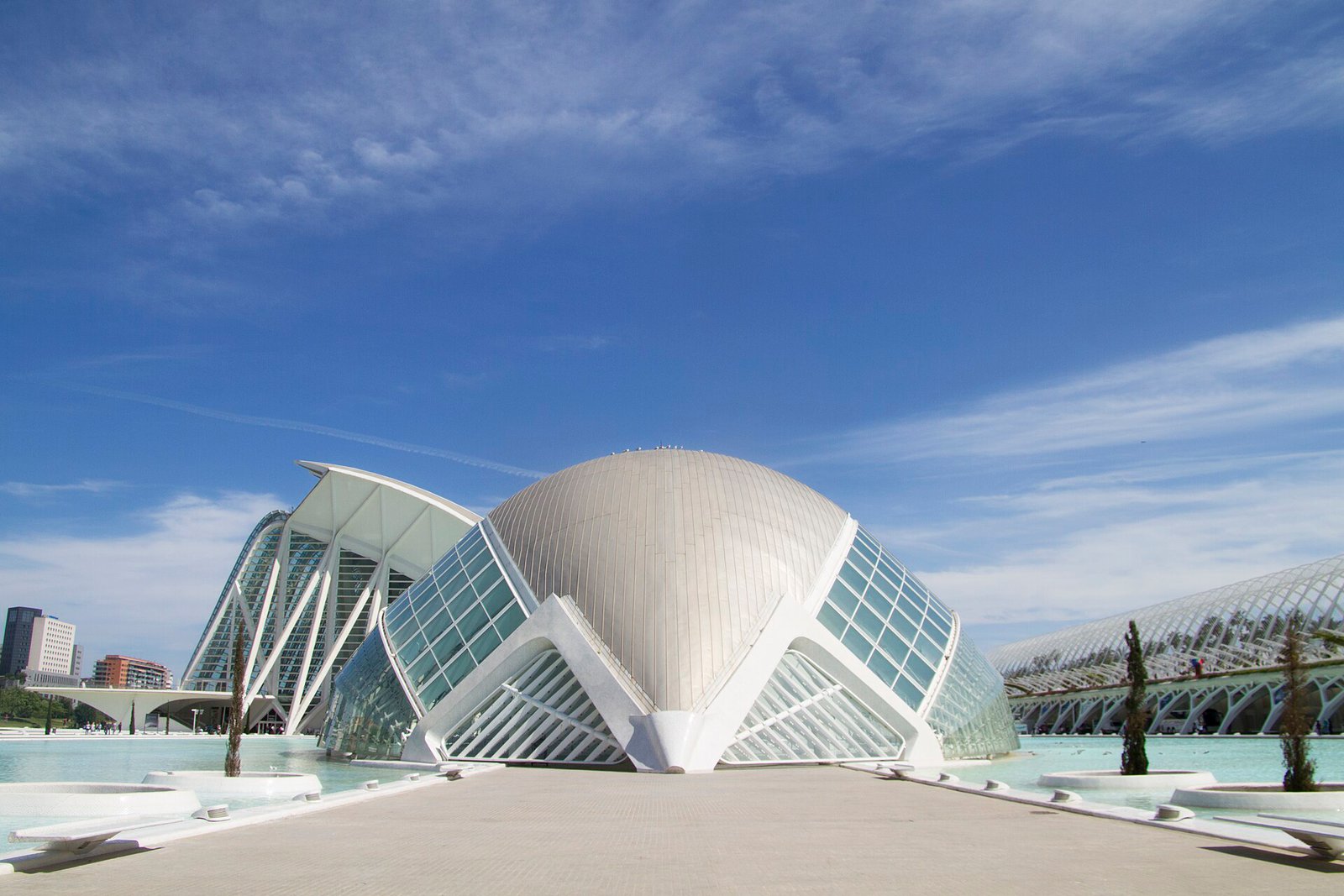
Santiago Calatrava's complex, built on the old riverbed: white concrete and broken-tile shells set in shallow blue pools, at a scale that makes people very small. There is nothing else like it in the country.
The pools are the reason to come. Everything reflects, so a low camera position gives you the structure twice, and on a still morning the water is a mirror. The eye-shaped Hemisfèric and the covered walkways of the Umbracle give shade and repeating arches when the open plaza is too bright.
The technical difficulty is real: white concrete in full Valencian sun blows out and throws light back up into faces. Early morning and the last hour are not a preference here, they are the working hours. Wind ripples the reflections from mid-morning, which is a second reason to be early.
The Turia gardens
After the 1957 flood the city moved its river and turned the empty bed into a park that curves right through the middle of everything. Nine kilometres of gardens, orange trees and lawns, sunk below street level and crossed by the old stone bridges.
Being sunk is what makes it useful. The banks and bridges cut the low sun, so there is usable shade through the middle of the day, and the bridge arches give a built frame at regular intervals.
It is also flat, wide and traffic-free for its entire length. With a pushchair or a toddler this is the easiest location in our whole catalogue — no cobbles, no stairs, no roads. Anyone who has tried a family session in the Albaicín will understand why that matters.
The old town and the beach
Between the two big locations, Valencia has an old town of narrow streets around the cathedral and the Mercado Central, an art-nouveau market hall with an iron and glass roof.
And it has Malvarrosa: a wide city beach at the end of a tram line, with a promenade of restaurants behind it. Not the most dramatic coast in Spain, but it is twenty minutes from the centre and it turns a city session into a city-and-sea one.
What Valencia gives you that the bigger cities do not
Space. Barcelona's locations are crowded and Madrid's are busy. Valencia's are not, which means a session moves at its own pace rather than negotiating for position.
Availability. Photographers here are easier to book at short notice and generally priced below Barcelona.
Range without distance. Futuristic architecture, a long green park, a historic centre and a beach, all within a few kilometres.
When to come
The climate is mild enough that Valencia works most of the year. July and August are hot but the sea helps, and the Turia's tree cover means midday is survivable in a way inland Andalusia is not.
The one date to know about is Las Fallas in March: enormous sculptures throughout the city, fireworks, and colossal crowds. Extraordinary to witness and impossible to schedule a session around.
A route that works
- Sunrise — the City of Arts and Sciences, still water and no wind
- Late morning — the Turia, walking the stretch between the Palau de la Música and the complex
- Midday — the old town and the Mercado Central, in the shade
- Late afternoon — Malvarrosa beach
Nine kilometres of park is too much to walk in a session, so pick one stretch. The section between the Palau de la Música and the City of Arts links the two best locations on foot.
The photographers covering Valencia know which side of the pools is still at eight in the morning, which is the sort of thing that decides whether the reflection shot works.
Frequently asked questions
What time of day should I photograph the City of Arts and Sciences?
Early morning and the last hour — these are not a preference but the working hours, because white concrete in full Valencian sun blows out and throws light back up into faces. Morning has a second advantage: the wind ripples the reflections from mid-morning, and on a still morning the pools are a mirror that gives you the structure twice from a low camera position. The Hemisfèric and the Umbracle's arches provide shade when the open plaza is too bright.
Is Valencia a good city for a family photoshoot with a pushchair?
It is the easiest Spanish city to photograph with small children. The Turia gardens — nine kilometres of park sunk into the old riverbed — are flat, wide and traffic-free for their entire length, with no cobbles, no stairs and no roads, and the banks and bridges give usable shade through the middle of the day. Pick one stretch: the section between the Palau de la Música and the City of Arts links the two best locations on foot.
When should I avoid Valencia for a photoshoot?
Las Fallas in March: enormous sculptures throughout the city, fireworks and colossal crowds — extraordinary to witness and impossible to schedule a session around. The rest of the year the mild climate works; July and August are hot but the sea helps, and the Turia's tree cover makes midday survivable in a way inland Andalusia is not.
Want professional photos in Valencia?
Browse portfolios, compare packages, and book a verified local photographer in minutes.